
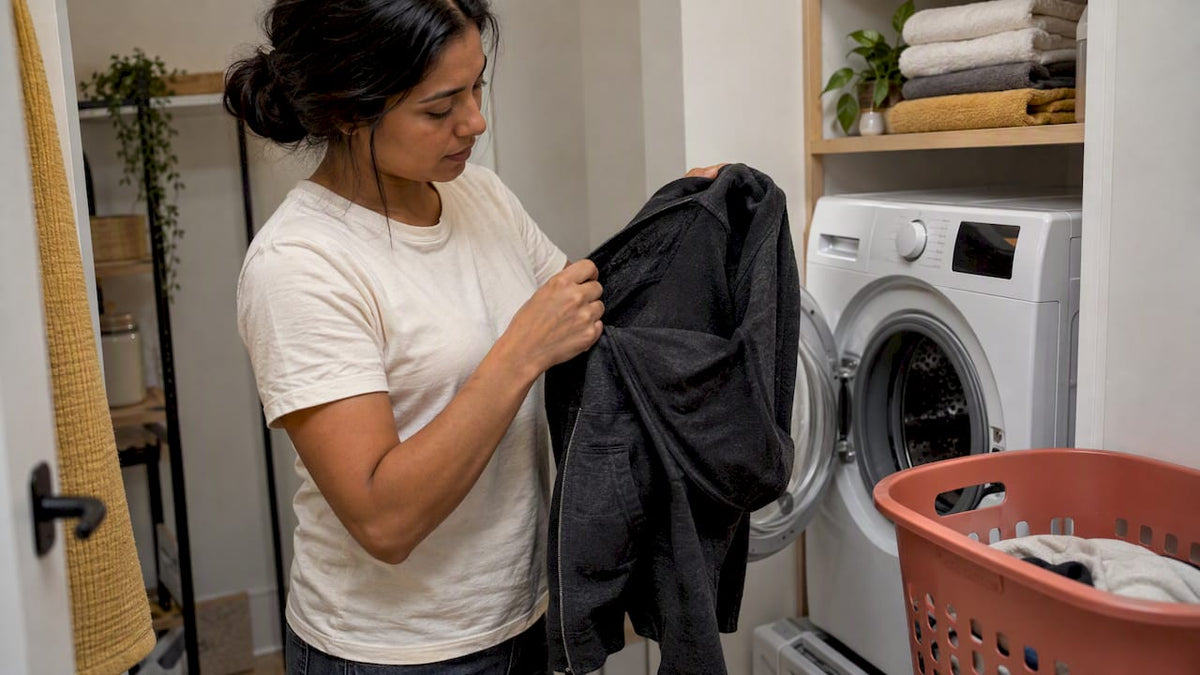
You can slow hoodie pilling a lot, but you can’t stop it for good. Pills are small balls of tangled fiber that form where fabric rubs, so the best defense is less friction: wash less often, turn the hoodie inside out, zip it, use cold water and a gentle cycle, skip the hot dryer, and keep bags and straps from grinding on the same spots. Choosing a denser fabric helps too. This guide walks through each step, explains why hoodies pill in the first place, and shows how to remove pills safely once they appear.
TL;DR
- Pills form when short, loose fibers on the surface rub, tangle and ball up. Friction is the trigger, in the washer, in the dryer and on your body.
- Wash only when needed, inside out, zipped, in cold water on a gentle cycle, and air-dry or use low heat.
- Rub points such as underarms, sleeves and bag straps pill first. Reduce the rubbing there.
- Pilling alone doesn’t mean a hoodie is poorly made, but fabric and yarn construction change how fast it happens.
- Remove existing pills with a fabric shaver or careful trimming, never by pulling hard.
Table of Contents
- Why hoodies pill
- Where pills show up first
- Wash less, and wash smarter
- Dry it gently
- Reduce friction while you wear it
- Which hoodie fabrics pill most
- Does pilling mean the hoodie is poor quality?
- Does pilling ever stop?
- How to remove pills without damaging the hoodie
- Our perspective
- A hoodie built for everyday wear
- FAQ
- Sources
Why hoodies pill
A hoodie is a soft, brushed or looped knit made of short fibers twisted into yarn. Ordinary wear pushes some of those fibers to the surface. UL Solutions, a textile-testing organization, explains that pills are groups of short, broken fibers that tangle into small balls on the surface of a garment, and that everyday abrasion is the usual cause.
Think of it as a three-step loop:
- Friction loosens fiber ends and pulls them out of the yarn.
- Those loose ends tangle with each other.
- The tangles stay anchored to the fabric, so they sit there as visible little balls.
The same UL page notes that short fibers such as cotton, and loosely constructed knits, are more likely to pill, while tighter twists hold up better to typical wear. That matters for hoodies, because cozy, fuzzy interiors are exactly the structure that sheds fiber ends.
It is also not one single cause. A 2024 paper in AIP Conference Proceedings lists fiber composition, yarn structure, fabric structure, manufacturing and laundering or drying among the interacting factors that determine how much a fabric pills. Some of those are fixed when the hoodie is made. The laundering, drying and wearing part is the one you control.
Where pills show up first
If you look at a hoodie that has been worn for a season, the pills are rarely evenly spread. Vogue notes that underarms, sleeves and the area under purse straps tend to pill early because they get more friction.
For a hoodie, add a few more suspects:
- Inner arms and sides of the torso: constant rubbing as you walk or move.
- Under a backpack or crossbody strap: shoulders and the chest line.
- Cuffs and pocket edges: hands go in and out all day.
- Drawstring and zipper areas: hard parts rub against soft fabric.
Knowing the pattern gives you a simple habit. If a bag always sits on the same shoulder, switch sides now and then. If you wear a hoodie under a jacket with a rough lining, expect extra wear in the same spots.
Wash less, and wash smarter
Every wash cycle is a long session of rubbing. The easiest way to cut it is to run fewer cycles. Hoodies that are worn over a base layer, or for a few hours, often just need airing out. Spot-clean small marks, and save a full wash for when the hoodie is actually dirty or sweaty.
When it does need a wash, this routine is consistent across appliance and care guidance:
Turn it inside out and close everything
Maytag’s care advice recommends turning garments inside out, fastening closures and checking the care label, which keeps the outer face away from the drum and from other clothes. Zip the zipper all the way up, and tie or tuck in the drawstring so the metal tips don’t whip against the fabric. Tide’s U.S. care guide also recommends turning garments inside out, along with a gentle cycle or hand wash.
Use a mesh bag
A mesh laundry bag adds a buffer between the hoodie and the drum. Maytag lists a mesh bag as a way to reduce abrasion. Pick a bag large enough that the hoodie isn’t compressed, since a tightly stuffed bag defeats the purpose.

Keep the load small and the fabrics alike
Crowded loads mean more clothes pressed against each other. Maytag advises against overloading the washer and sorting by fabric type. In practice, wash your hoodie with other soft knits, not with jeans, towels or anything with hook-and-loop tape. Rough fabrics act like sandpaper on soft ones, and towels shed lint that sticks to fleece and brushed cotton.
Cold water, gentle cycle, slower spin
Maytag recommends a gentle or delicate cycle with slower spin speeds. Cold water is easier on fibers and is a good default for hoodies with prints or dark dyes. If you want a tested example of this routine written for hoodie owners, see this guide to washing hoodies in cold water on a gentle cycle with low spin.
Skip fabric softener
It feels counterintuitive, because softener makes clothes feel smoother. But The Woolmark Company, which sets care standards for wool, recommends avoiding fabric softener alongside reducing abrasion and turning garments inside out. Use a detergent that rinses clean and the correct dose, so residue doesn’t stay in the knit.
A quick wash routine
| Step | Do | Avoid |
|---|---|---|
| Before washing | Zip up, tuck drawstrings, turn inside out | Washing with jeans, towels or hook-and-loop items |
| Loading | Mesh bag, half-full drum | Packing the washer tight |
| Settings | Cold, gentle or delicate, slower spin | Hot water, heavy-duty cycles |
| Detergent | Measured dose that rinses clean | Softener, extra detergent |
| Drying | Air-dry flat or low heat | High heat, long tumbling |
Dry it gently
The dryer is another round of tumbling. Maytag recommends air-drying or low dryer heat and notes that high heat may damage fibers that are already loose and starting to break. Tide’s care guidance also points to air-drying flat. A hoodie dried flat or draped over a rack keeps its shape and sheds less fiber.
If you need the dryer for time reasons, use the lowest heat, remove the hoodie while it’s still slightly damp, and finish it on a rack. Check the care label first, since the label is the final word on what your specific fabric tolerates.
While hoodies shrink in other ways too, our guides on how to wash heavyweight T-shirts cover the same cold-wash, low-heat logic for fit, and that advice carries over to heavyweight knits of any kind.

Reduce friction while you wear it
Laundry is only half of it. Wear is the other half, and it explains why two identical hoodies can look different after a year.
- Rotate bags and shoulders. A backpack strap or purse always on one side wears one patch of fabric.
- Mind hook-and-loop closures. Velcro on jacket cuffs, gym bags and backpack waist belts snags soft knits.
- Rotate your hoodies. Wearing the same one daily concentrates wear. Two or three in rotation each get time to rest.
- Fold, don’t hang. UNIQLO’s U.S. knitwear care guide advises folding knits rather than hanging them. Hanging can stretch a heavy hoodie at the shoulders and put strain on the neckline.
- Remove pills early. Patagonia suggests removing pills before washing helps avoid fraying more surface fibers, so a quick pass with a shaver before laundry day can be worth it.
If you travel often, remember that a hoodie crammed into a bag with zippers and rough items takes a beating too. Our piece on packing hoodies for travel covers how to fold and protect them in a carry-on.
Which hoodie fabrics pill most
No hoodie fabric is immune, but some constructions hold up better than others.
- Short-staple cotton and loose knits are more likely to pill, according to UL Solutions. Tighter twists resist typical wear.
- Blended fabrics can be especially prone: Vogue explains that weaker fibers break while stronger ones hold the pills in place, so the pills stay put instead of falling off. It also lists soft knits, wool, cashmere and cotton-polyester blends as commonly affected.
- Yarn and fabric structure matter as much as fiber type. The AIP paper treats yarn structure and fabric structure as separate determinants of pilling.
That is why the question isn’t simply cotton versus polyester. A dense, tightly spun cotton can resist pilling better than a loose, lightweight blend, and a smooth French terry behaves differently from a brushed fleece. If you’re deciding between the two, our comparison of cotton vs polyester hoodies covers French terry layers and fleece warmth. For a look at how yarn quality is judged, see our note on blank hoodie quality, which starts with the face yarn.
What to look for when buying
- A smooth, dense face on the outside of the fabric, not a loose fuzzy surface.
- Weight and structure that feel substantial. A heavyweight hoodie is built for durability as well as warmth.
- A simple fiber blend you can read on the label, so you know how to wash it.
Press your thumb across the fabric and look at the surface in strong light. Existing fuzz in a new garment is a warning sign.
Does pilling mean the hoodie is poor quality?
Not by itself. Wirecutter reports that most fabrics eventually pill with repeated wear and that pilling isn’t necessarily evidence of poor quality. Vogue makes the same point, noting that even premium cashmere can pill. UL Solutions frames pilling as mainly a surface-abrasion effect rather than a defect.
What counts as a quality problem is speed and extent. A hoodie that pills heavily after a handful of gentle washes, or pills across the whole surface, likely has a loose knit or weak yarn. A hoodie with a few pills at the underarms after a year of heavy use is behaving normally.
Does pilling ever stop?
Usually it slows rather than stops. The Woolmark Company says pilling can’t be guaranteed away entirely, and the best you can do is reduce abrasion. As a surface layer of loose fiber ends wears off and pills are removed, the fabric often produces fewer new ones, but continued friction keeps loosening fibers. Treat it as ongoing maintenance, not a one-time fix.
How to remove pills without damaging the hoodie
Once pills form, you can remove them, though nothing restores the fabric to brand new. Wirecutter notes a fabric shaver can improve how a garment looks but may not extend its lifespan, so think of it as grooming.
- Lay the hoodie flat on a table or ironing board so the fabric is smooth and slightly taut.
- Use a fabric shaver. Glide it lightly over the pilled area. Don’t press, since pressing can cut into the knit.
- Or use a sweater comb or careful trimming. UNIQLO’s U.S. knitwear guidance mentions a fabric shaver or careful trimming of pills with scissors. Lift each pill and snip it, and never cut the fabric itself.
- Don’t yank. Pulling pills can drag more fibers out of the yarn and make new ones.
- Do it before washing, and shake or lint-roll off the debris.
Go slowly on seams, ribbing, prints and logos, where shavers can catch or damage the surface. Test on a hidden area, such as inside the hem, first.
Our perspective
We make heavyweight basics and we care about how they age, so here is where we land. Most hoodie pilling is a care and friction problem as much as a fabric one, which is encouraging, because you control the care. A dense, substantial knit gives you a better starting point, but even the best one rewards a cold, gentle wash and a rack to dry on.
We also think people worry too much about the first pills. A few at the underarm is a sign the hoodie is getting worn, not a failure. What matters is whether you can slow the process and keep the hoodie looking sharp. Wash less, turn it inside out, zip it, keep it away from rough items, and groom the surface when needed. The same logic applies to every heavyweight piece in your closet, and it is simple enough to become a habit.
— Ash
A hoodie built for everyday wear
If your current hoodie is past saving, our No BS Basics collection covers premium unbranded essentials, including the Essential Heavyweight Zip Hoodie. Pair it with a mesh bag from our travel organizers, and you have what you need to keep it in good shape on the road or at the gym.
FAQ
How do I stop my hoodie from pilling in the wash?
Wash it only when needed, turned inside out and zipped, in cold water on a gentle cycle with a slow spin. Use a mesh bag, don’t overload the washer, and keep it away from jeans and towels. Skip fabric softener.
Why is my 100% cotton hoodie pilling?
Cotton fibers are short, and short fibers work loose from the yarn easily, especially in a loosely spun or brushed knit. UL Solutions notes that short fibers and loose constructions are more likely to pill. Friction at the underarms, sleeves and under bag straps speeds it up.
Does pilling mean a hoodie is poor quality?
Not on its own. Wirecutter reports that most fabrics eventually pill with repeated wear. Heavy pilling after only a few gentle washes can point to a loose knit or weak yarn, though.
Can I remove pills from a hoodie safely?
Yes. Lay the hoodie flat and use a fabric shaver with light strokes, or carefully trim pills with small scissors. Don’t pull them off by hand, and test on a hidden area first.
Does pilling ever stop?
Usually it slows rather than ends. Woolmark says pilling can’t be completely guaranteed away, so lower friction and gentle care are the practical goal.
Sources
- Untangling the How, What and Why of Textile Pills, UL Solutions
- Causes and methods for determining the pilling ability of fabrics, AIP Conference Proceedings
- How to Remove Pilling From Clothes, Vogue
- How to Prevent & Remove Fabric Pilling, Maytag
- How to Depill a Sweater, Tide
- What is pilling?, The Woolmark Company
- Read This Before You Take a Fabric Shaver to Your Favorite Sweater, Wirecutter




Share and get 15% off!
Simply share this product on one of the following social networks and you will unlock 15% off!