
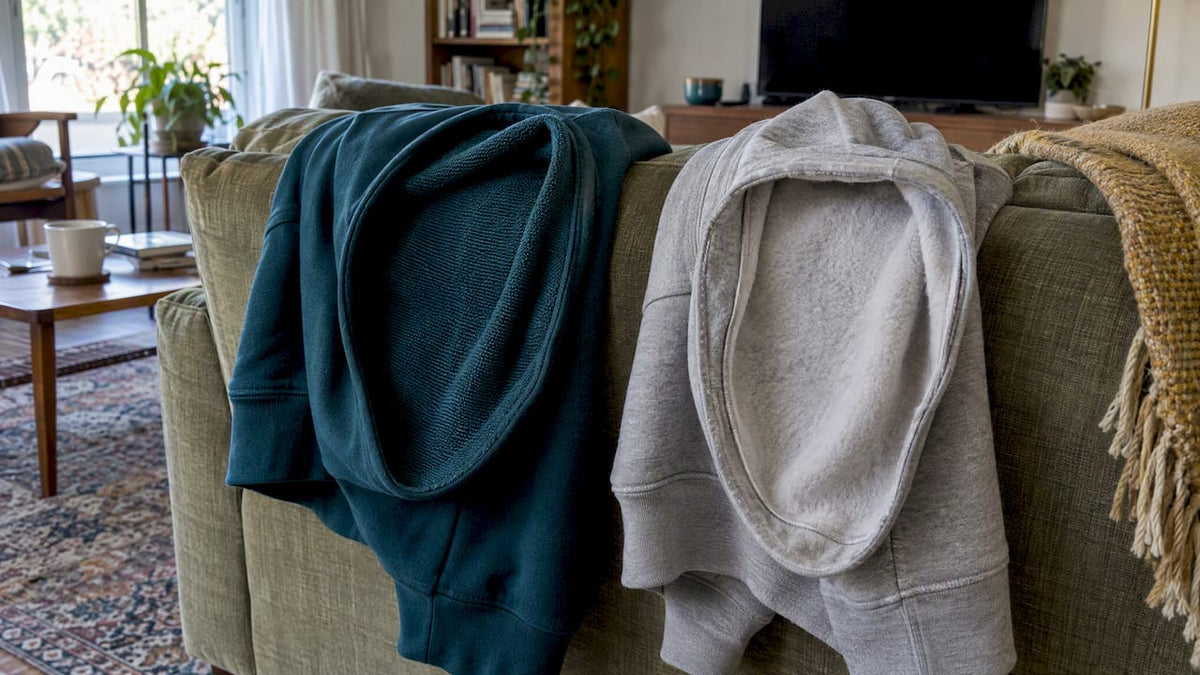
Choose cotton-rich hoodies when comfort, softness, and breathability matter most, like lounging, daily wear, or mild activity. Choose polyester-rich hoodies when you need fast drying, shape retention, and long-term durability, especially for travel or workouts. For most shoppers, a well-chosen cotton-polyester blend delivers the best of both without forcing a tradeoff.
TL;DR:
- For high intensity workouts, choose a blend containing at least 65% polyester in French terry; brushed fleece traps heat for cold, low activity.
- An 80/20 cotton and polyester blend favors softness, a 70/30 blend handles frequent washing, and 60/40 or 50/50 blends suit travel.
- Wash hoodies in cold water, turn them inside out, and air dry or use low heat to reduce shrinkage, pilling, and fading.
- If you have sensitive skin, wash a new hoodie before wearing it and consider undyed options, since dyes or finishing chemicals can trigger reactions.
- Consider recycled content when weighing environmental impact: cotton farming uses water and land, while polyester production depends on petrochemical inputs.
Table of Contents
- Cotton vs Polyester for Hoodies at a Glance
- How Cotton and Polyester Perform During Activity, Travel, and Everyday Wear
- French Terry vs Fleece: Warmth, Weight, and Seasonality
- Shrinkage, Pilling, and the Washing Habits That Protect Your Hoodie
- Blend Ratios That Actually Match How You’ll Wear the Hoodie
- What the Research Says About Fiber Choice and Fabric Finishing
- Allergy and Skin Sensitivity: What to Watch For
- Color Retention and Fading Over Time
- Choosing Based on What You Actually Need, Not What Sounds Best
- How Our No BS Basics Hoodies Fit This Framework
- FAQ
- Sources
Cotton vs Polyester for Hoodies at a Glance
Before you dig into fabric weights and blend ratios, it helps to see the core tradeoffs side by side. Cotton and polyester solve different problems, and knowing which one matches your priorities saves you from buying a hoodie that fights your lifestyle.
Cotton brings a few clear strengths to the table:
- Breathability: Cotton fibers let air move freely, which keeps you cooler during low-intensity wear.
- Hand-feel: Cotton has a soft, natural texture that many people prefer against the skin.
- Absorbency: Cotton can hold onto moisture, including sweat, rather than pushing it to the surface.
Polyester answers with a different set of advantages:
- Wicking and dry time: Polyester moves moisture to the fabric surface, where it evaporates faster.
- Durability: Polyester resists stretching, abrasion, and shape loss over repeated wear and washing.
- Wrinkle resistance and cost: Polyester holds its shape out of the dryer and typically costs less to produce, which can translate into a lower price tag.
Environmental considerations complicate the picture on both sides. Cotton farming uses significant water and land, while polyester production relies on petrochemical inputs. We’ll walk through the lifecycle tradeoffs in more detail later, but neither fiber wins outright on sustainability. The right choice depends on how you plan to wear the hoodie, not which fabric sounds greener on paper.
How Cotton and Polyester Perform During Activity, Travel, and Everyday Wear
The fabric that feels great on your couch isn’t always the one you want at the gym or on a long flight. Fiber content changes how a hoodie handles sweat, movement, and recovery time between wears.
Polyester’s structure is why it dominates activewear. Activewear fabric guidance notes that polyester wicks moisture away from the skin and dries faster than cotton, which is why so many performance hoodies lean synthetic. That same guidance recommends matching fabric to activity level and climate: cotton and blends for lighter workouts and everyday wear, polyester for high-intensity or outdoor use.
Cotton earns its place in lower-exertion settings. Because it absorbs rather than wicks, cotton feels soft and stable when you’re not sweating heavily, which makes it a natural fit for lounging, errands, or mild weather.
Construction matters as much as fiber here. A French terry hoodie breathes better than a brushed fleece one, so it handles light activity or warmer climates more comfortably, while fleece’s napped interior traps air and suits colder, less active settings.
Here’s how that plays out in practice:
- Gym sessions: Reach for a polyester or poly-blend hoodie with French terry construction to manage sweat without overheating.
- Air travel: A cotton-poly blend balances the comfort you want sitting for hours with the wrinkle resistance you need after being packed in a bag.
- Cold-weather layering: Brushed fleece in a cotton-rich blend adds warmth without the clammy feel polyester can create in very cold, low-sweat conditions.
- Everyday errands: Pure cotton or cotton-dominant blends offer the softest, most breathable option when performance isn’t the priority.
Pro Tip: If you only own one hoodie for both travel and the gym, a 60/40 or 50/50 cotton-poly blend in French terry construction covers the widest range of conditions.
French Terry vs Fleece: Warmth, Weight, and Seasonality
The inner surface of a hoodie changes how warm it feels just as much as the fiber content does. French terry uses uncut loops on the inside, which keeps airflow moving and makes it a strong layering piece. Brushed or napped fleece brushes those loops into a soft pile that traps air, which is what gives fleece hoodies their heavier, cozier feel; for practical guidance on fleece weight and use cases, check out this fleece weight guide.
Comparisons of the two constructions show that French terry breathes better and suits transitional weather or layering, while fleece’s trapped air delivers more warmth for standalone cold-weather wear. That difference shows up clearly once you look at typical fabric weights.

If you’re printing or embroidering a design on the hoodie, construction matters here too. French terry’s flatter surface takes prints cleanly, while fleece’s texture can soften fine details. For a deeper look at how fabric weight affects everyday performance, our breakdown of what GSM means in clothing walks through the numbers in more detail, and our heavyweight hoodie guide covers why heavier fabric often means better long-term value.
Shrinkage, Pilling, and the Washing Habits That Protect Your Hoodie
Fiber content shapes how your hoodie ages, and a few wash habits make a bigger difference than most people expect. Blending in polyester adds structural stability, which is why a 50/50 or 60/40 blend typically holds its shape better over repeated washes than pure cotton.
Pilling tells a similar story. Polyester’s synthetic fibers resist abrasion well, but loose polyester fibers can still ball up on high-friction areas like underarms and waistbands. Cotton pills less from abrasion but can look worn through fading and surface fuzzing over time, especially on brushed fleece.
A short checklist keeps either fabric looking newer longer:
- Wash cold: Cold water reduces fiber swelling and shrinkage risk for cotton and blends alike.
- Skip the high heat dryer setting: Air drying or low heat protects both GSM and shape, which our guide on washing heavyweight tees covers in more detail.
- Turn it inside out: This reduces surface friction that causes pilling on the outer face.
- Wash similar fabrics together: Mixing rough and smooth textures accelerates pilling on softer fabrics.
Polyester can cost 40 to 60% less to produce than 100% cotton for equivalent fabric weight, which is part of why synthetic and blended hoodies often carry lower price tags. That upfront savings doesn’t always translate into lower lifetime cost, since a cotton-rich hoodie with proper care can outlast a cheaply made polyester one in both feel and fit.
Blend Ratios That Actually Match How You’ll Wear the Hoodie
Reading a hoodie’s fabric label tells you almost everything you need to know about how it will perform. Blend ratios aren’t arbitrary. Manufacturers choose them to balance softness, durability, and cost for specific uses.
- 80/20 cotton-poly: Prioritizes cotton’s soft hand while adding just enough polyester for shape retention. Good for daily comfort hoodies you’ll wear often.
- 70/30 cotton-poly: A slightly more durable step up from 80/20, still soft enough for everyday wear but better suited to frequent washing.
- 60/40 or 50/50 cotton-poly: Balances comfort and performance evenly, making it a strong pick for travel hoodies that need to resist wrinkling and dry quickly between wears.
- 35/65 or heavier poly blends: Leans into durability and moisture management for athletic or heavy-duty workwear, where shape retention under stress matters more than hand-feel.
Treated cotton finishes add another option worth knowing about. TransDRY treatments modify cotton fibers to improve evaporation and reduce moisture retention, narrowing the performance gap with polyester while keeping cotton’s natural feel. If you love cotton’s softness but need better dry time for travel or light activity, a TransDRY-treated cotton hoodie is worth seeking out over an untreated one.
What the Research Says About Fiber Choice and Fabric Finishing
Life-cycle research adds useful context to the comfort-versus-performance debate. Textile Exchange’s polyester life-cycle summary points to petrochemical inputs and energy use as the main impact drivers, while noting that recycling methods, both thermomechanical and chemical, shift the impact profile in different ways. That means a blanket “synthetic is worse” claim doesn’t hold up once recycled content enters the picture.
Life-cycle impacts complicate simple “natural vs synthetic” claims; recycled polyester and better recycling infrastructure change the sustainability picture.
On the cotton side, moisture regain data shows cotton holds roughly 7 to 8.5% moisture against polyester’s 0.4%, which is the technical reason cotton feels damp longer after a workout. Treatments like TransDRY close part of that gap without sacrificing cotton’s hand-feel, which is exactly the kind of practical nuance we try to bring to the hoodies we carry.
Allergy and Skin Sensitivity: What to Watch For
Fiber choice can matter a lot if you have sensitive skin, though the reasons are more about finishing than fiber alone. Cotton is generally gentler on reactive skin because it’s breathable and rarely triggers contact irritation on its own. Most reported “cotton allergies” are actually reactions to dyes, finishing chemicals, or formaldehyde-based wrinkle treatments applied during manufacturing, not the fiber itself.
Polyester can trap heat and moisture against the skin in people who sweat heavily, which sometimes worsens conditions like eczema or heat rash, even though the fiber isn’t inherently irritating. Blended fabrics tend to split the difference, though the blend ratio and finishing chemicals used still matter more than the raw cotton-to-polyester split.
If you have known sensitivities, a few habits help regardless of fabric choice. Washing a new hoodie before the first wear removes residual processing chemicals. Choosing undyed or lightly dyed options reduces exposure to reactive pigments. Looking for brands that skip formaldehyde-based finishes, common in wrinkle-resistant cotton treatments, is worth the extra label-reading if you react to synthetic fabrics in other contexts.
Neither fiber is universally hypoallergenic, so if you’ve had reactions before, patch-testing a new hoodie against a small area of skin before wearing it all day is a reasonable precaution.
Color Retention and Fading Over Time
How well a hoodie holds its color depends on fiber type, dye method, and care habits working together, not any single factor alone. Polyester generally resists fading better than cotton because synthetic fibers bond more tightly with disperse dyes used in production, which is part of why polyester activewear often looks vibrant even after heavy wash cycles.
Cotton’s natural fiber structure absorbs dye differently, which can mean richer initial color but faster fading, especially with repeated washing in hot water or high heat drying. Reactive dyes used on quality cotton garments hold up better than cheaper pigment dyes, so the dyeing method matters as much as the fiber itself.
Blended fabrics face a unique challenge: cotton and polyester fibers can take dye unevenly, which sometimes creates a slightly muted or heathered look rather than a flat, uniform color. That’s not a flaw so much as a visual signature of blended fabric, and it’s often intentional in casual hoodie designs.
A few care habits protect color regardless of fiber content. Washing in cold water, turning garments inside out, and avoiding high heat drying all slow fading across cotton, polyester, and blends alike. Dark colors fade faster than light ones under the same wash conditions simply because color loss is more visible against a saturated base.

Choosing Based on What You Actually Need, Not What Sounds Best
The honest framework here isn’t cotton versus polyester, it’s priority versus priority. If comfort and breathability matter most, lean cotton. If performance and durability matter most, lean polyester. If you want to stop thinking about it altogether, a cotton-poly blend in the 60/40 to 50/50 range covers the widest range of situations without asking you to compromise hard on either side.
For most people buying one hoodie to do everything, that blend is the practical answer.
— Ash
How Our No BS Basics Hoodies Fit This Framework
We built our No BS Basics hoodies around the same tradeoffs we just walked through, not around trends. Here’s how the line lines up with what you’ve read above:
- Heavyweight fleece construction gives you the warmth and shape retention we covered in the GSM breakdown, without the thin, flimsy feel of cheaper hoodies.
- Boxy, structured fit holds up to repeated washing better than a loosely blended, lightweight alternative.
- Unbranded, straightforward design means you’re paying for fabric quality, not a logo markup.

If the heavyweight fleece category sounds like your pick after reading through the warmth and durability sections above, our No BS Basics heavyweight boxy fleece hoodie is built exactly for that use case. Browse the full No BS Basics collection to compare weights and fits, and check the product page for current return policy details before you order.
FAQ
Is polyester a good material for a hoodie?
Yes, polyester works well for hoodies that need fast drying, shape retention, and durability, especially for workouts or travel. It resists wrinkling and holds up to repeated washing better than cotton, though it can trap heat and moisture against the skin during heavy sweating.
Is fleece similar to cotton?
Fleece isn’t a fiber, it’s a construction, and it can be made from cotton, polyester, or a blend of both. Brushed or napped fleece creates a soft pile that traps air for warmth, while the underlying fiber content still determines breathability and moisture handling.
Do you sweat more wearing polyester or cotton?
You don’t necessarily sweat more in either fabric, but the fabrics handle sweat differently. Cotton absorbs moisture and can feel damp and heavy, while polyester wicks moisture to the surface where it evaporates faster, which is why activewear guidance favors polyester for high-intensity activity.
What is the softest material for hoodies?
Cotton generally offers the softest hand-feel, especially in brushed fleece or French terry construction, because its natural fibers feel gentle against the skin. Treated cotton finishes like TransDRY can improve performance while keeping that same soft feel intact.
Sources
- TransDRY brochure (CottonWorks)
- Activewear fabric guide (Utah State Extension)
- Polyester LCA summary (Textile Exchange)
- French terry vs fleece guide (ThreeLayer)





साझा करें और 15% छूट पाएं!
बस इस उत्पाद को निम्नलिखित सामाजिक नेटवर्क में से किसी एक पर साझा करें और आपको 15% की छूट मिलेगी!