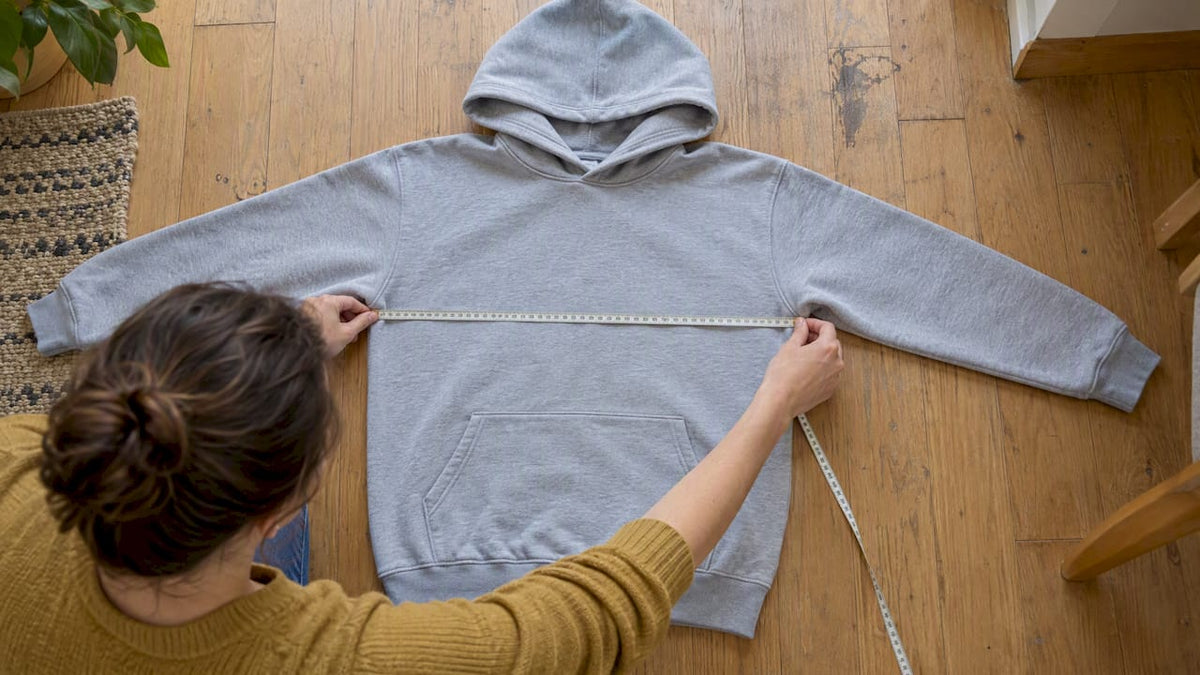
The single number that decides your hoodie size is the garment pit-to-pit, the flat chest width measured across the front. Double that number to get the full chest circumference, then compare it against your own chest measurement, aiming for 4 to 6 inches of ease. Size up one if you want an oversized look or plan to layer heavily; otherwise stay true to size. Two quick checks confirm you got it right: the shoulder seam sits where it should, and you can pinch 1 to 2 inches of fabric at the chest.
TL;DR:
- Use each brand’s measurements over generic charts, allow about half an inch of tolerance, and compare sleeve figures only when brands use the same method.
- Choose a true oversized pattern instead of sizing up a regular hoodie; fabric under 300 GSM can collapse, while 400 GSM or heavier holds shape.
- Cotton fleece can lose up to an inch of length with hot washing and high heat drying, so frequent warm washing favors sizing up.
- Broad shoulders should prioritize shoulder seam placement over chest alone, while taller frames should check sleeve and body length or seek tall cuts.
Table of Contents
- Hoodie size chart: what the numbers mean
- How to measure a hoodie and your body correctly
- Slim, regular, relaxed, and oversized: how fit and fabric weight interact
- Choosing your final size: between sizes, layering, and body length
- Worked examples: from pit-to-pit to a size you can order
- Finding your fit by body type: petite, tall, and broad-shouldered frames
- Accounting for shrinkage and stretch before you commit to a size
- A quick note before you order
- Where to find a hoodie built from clear, measured specs
- FAQ
- Sources
Hoodie size chart: what the numbers mean
A representative unisex hoodie size chart gives you a starting point before you check any single brand’s own specs. Pit-to-pit is measured flat, armpit to armpit across the front of the garment; full chest is simply that number doubled, since the garment is folded when you measure it. Body length runs from the high point of the shoulder (HPS) down to the hem.
This range reflects what many unisex pullover charts list across XS through 3XL, with pit-to-pit figures grading roughly 2 inches per size step and body length climbing from about 25 to 32 inches. Treat these numbers as a reference, not gospel. Expect roughly a half inch of tolerance on any single measurement due to fabric stretch and how the garment was laid flat when measured. When a brand publishes its own chart on a product page, that chart wins over any generic table, since cut and grading vary between manufacturers even at the same labeled size.
How to measure a hoodie and your body correctly
Getting a usable number takes about five minutes if you follow a consistent method both on the garment and on yourself.
To measure a hoodie you already own:
- Lay it flat on a table and smooth out any wrinkles or folds.
- For zip hoodies, zip it closed first so the front lies flat and even.
- Measure the chest about 1 inch below the armhole, armpit to armpit, then double that number for full chest.
- Measure body length from the high point of the shoulder seam straight down to the hem.
- Measure the sleeve along the seam from shoulder to cuff, noting that some brands measure from the center back of the neck instead.
To measure your own body, wrap a tape around the fullest part of your chest, keep it level front to back, and breathe normally rather than puffing out your chest. The most common error is forgetting to double the pit-to-pit figure, which makes a hoodie look two sizes smaller than it actually runs. A second common mix-up happens with sleeve length: brands disagree on whether they measure from the shoulder seam or the center back of the neck, so compare like methods before assuming a sleeve runs long or short.
Slim, regular, relaxed, and oversized: how fit and fabric weight interact
Each silhouette comes from specific construction choices, not just a size label. A slim fit uses a set-in sleeve and minimal chest ease, following your body’s lines closely. A regular fit adds a bit more room through the chest and body while keeping the shoulder seam at or near your actual shoulder point. A relaxed fit extends both chest ease and body length modestly. True oversized fits use a drop-shoulder construction, where the seam sits 2 to 4 inches below your natural shoulder, along with extra body length and a boxier silhouette.
Fabric weight changes how each of these silhouettes actually looks on you; for those wanting a deeper understanding of fabric weight and fit, see this detailed guide on choosing a hoodie or sweatshirt by weight and fit.
- Lightweight fabric under roughly 300 GSM tends to drape and can collapse in an oversized cut, losing its boxy shape.
- Midweight fabric around 300 to 400 GSM holds a balanced shape for regular and relaxed fits.
- Heavyweight fabric at 400 GSM or higher supports structure in oversized silhouettes without sagging.
Pro Tip: If you want a true oversized look, shop for a pattern actually cut as oversized rather than buying a regular-fit hoodie two sizes up, since the neck and sleeves will sit wrong on a simply upsized regular cut.
Choosing your final size: between sizes, layering, and body length
Once you have your numbers, a few practical rules settle most sizing decisions. If you fall between two sizes, size up one for an oversized look or if you plan to layer a sweater or jacket underneath regularly; otherwise, choose true to size for everyday wear. Taller frames, roughly 5’10" and above, tend to carry oversized styles more easily and may also want to check for tall-specific cuts with extra body and sleeve length. Shorter frames usually look better in a true-to-size or lightly oversized fit rather than sizing up multiple steps, which can swamp a smaller frame in excess fabric.
Before you check out, run through this list:
- The shoulder seam sits at or near the natural shoulder point for a regular fit, or 2 to 4 inches lower for oversized.
- You can pinch 1 to 2 inches of fabric at the chest when the hoodie is zipped or pulled on.
- Sleeves end at the wrist bone with a slight break, not bunched or riding up.
- The hem falls between your hip bone and mid-fly, or lower if you want a boxier oversized length.
- Check the care label for shrink potential, since cotton-heavy fleece can lose a size’s worth of length after a hot wash and dryer cycle.
Worked examples: from pit-to-pit to a size you can order
Seeing a few examples side by side makes the math concrete. A pit-to-pit of 22 inches doubles to a 44-inch full chest, which commonly lines up with a medium or large depending on the brand’s grading.
| Pit-to-pit (in) | Full chest (in) | Regular fit label | Oversized preference |
|---|---|---|---|
| — | 40 | S | M |
| 22 | 44 | M | L |
| — | 44 | L | XL |
| 26 | 52 | XL | 2XL |
For a 5’10" male with a chest around 40 to 42 inches, a medium to large in a regular-fit hoodie usually lines up well, though it’s worth double-checking sleeve length since taller frames sometimes find standard sleeves landing above the wrist bone. A few notes apply across every row:
- Grading can shift by about half an inch to an inch between brands at the same labeled size.
- When a product page lists its own garment measurements, trust that over the generic label, since actual pit-to-pit and body length vary by manufacturer even within the same size name.
Finding your fit by body type: petite, tall, and broad-shouldered frames
Your frame shape matters as much as your overall size when a hoodie’s proportions are the goal. If you have a petite or shorter frame, a true-to-size pick in a regular fit usually looks cleaner than an oversized style, since excess body length and drop-shoulder construction can overwhelm a smaller torso. If you still want the oversized look, choose the smallest size in an actual oversized pattern rather than sizing up a regular cut, since that keeps the proportions intact while the exterior shape remains honest to your height.
Taller frames benefit from checking body length and sleeve length as closely as chest width, since a chart match on the chest can still leave sleeves ending above the wrist or a hem that rides up when you raise your arms. Some brands offer tall-specific cuts with extra length built into both the body and sleeve, which is worth seeking out if you are consistently finding standard hoodies run short on you.
Broad shoulders call for prioritizing the shoulder seam placement over the chest number alone. If the chest measurement fits but the shoulder seam sits too far in toward your neck, the whole hoodie will feel tight across the back and upper arms even though the chest pinch test passes. In that case, sizing up one step, or choosing a drop-shoulder oversized construction that naturally sits wider, usually solves the problem without creating excess room everywhere else.
Accounting for shrinkage and stretch before you commit to a size
Fabric behavior after washing changes how a hoodie fits over time, so it’s worth factoring into your size choice up front. Cotton fleece, especially heavier cotton-rich blends, can shrink noticeably in length and width after a hot wash and high-heat dryer cycle, sometimes losing close to half an inch to a full inch in body length. Cotton-polyester blends shrink less, since the synthetic fiber resists heat-driven contraction better than pure cotton.
Checking the care label before you buy gives you a reasonable preview: a tag that calls for cold wash and lay-flat or low-heat drying signals a fabric built to hold its original measurements, while a hot wash and tumble-dry label suggests some shrink is likely over the garment’s life. If you are between sizes and know you will wash a hoodie frequently on warm settings, leaning toward the larger size gives you room to absorb that shrink without the fit becoming noticeably tighter after a few washes. The reverse applies to stretch: looser knit fleece and lighter jersey-style hoodies can stretch out slightly with wear, so a snug fit at purchase may relax into a better fit after a few wears rather than staying tight indefinitely.

A quick note before you order
Our best advice: measure a hoodie you already own and love before you buy another one. Lay it flat, note the pit-to-pit and body length, and keep those two numbers on hand. Comparing them against any new product’s listed specs takes thirty seconds and prevents most sizing surprises. When a product page lists its own garment measurements, use those over a generic chart since actual cut varies between makers even within the same labeled size.
— Ash
Where to find a hoodie built from clear, measured specs
Once you know your numbers, shopping gets a lot simpler. Our No BS Basics collection includes a heavyweight boxy fleece hoodie built for a structured oversized look, with garment measurements listed right on the product page so you can match pit-to-pit and body length before you buy rather than guessing from a size label alone.
Pull your own hoodie measurements first, then compare them against our heavyweight boxy fleece hoodie specs to see exactly how it will sit on you before you check out.
FAQ
How do I know my hoodie size?
Measure a hoodie you already like flat across the chest, pit to pit, then double that number to get your full chest circumference and compare it to your own chest measurement. Aim for 4 to 6 inches of ease over your body measurement for a standard fit, and more if you want an oversized look.
Should I get a large or extra-large hoodie?
It depends on your chest measurement and how you want the hoodie to fit: if your full chest falls closer to a large’s range on the size chart, stick with large for a regular fit. Choose extra-large instead if you prefer an oversized, boxier silhouette or plan to layer heavily underneath.
What size hoodie fits a 5’10" male?
A 5’10" male with a chest around 40 to 42 inches typically fits a medium to large in a regular-fit hoodie, though it’s worth double-checking sleeve length since taller frames sometimes find standard sleeves landing above the wrist bone. Taller frames generally wear oversized styles well, so sizing up to a large or extra-large works if that look is the goal.
What size is extra-large in a hoodie?
In a standard unisex chart, extra-large typically corresponds to a pit-to-pit of about 26 inches, which doubles to roughly a 52-inch full chest, with a body length around 30 inches. Exact numbers vary by brand, so checking the specific product’s own garment measurements is more reliable than relying on the label alone.
Sources
- Fit and size guidelines for mens hoodies
- Hoodie size chart - MFG Merch
- Hoodie sizing guide — perfect fit
- Unisex Hoodie Size Chart: Pullover Measurements – Arklavo





साझा करें और 15% छूट पाएं!
बस इस उत्पाद को निम्नलिखित सामाजिक नेटवर्क में से किसी एक पर साझा करें और आपको 15% की छूट मिलेगी!