
Premium Basics vs Fast Fashion: What's The Actual Difference?
Not all expensive basics are good. Not all cheap basics are bad. Here's what actually separates one from the other — and where the money goes when you pay more.
The fast fashion basic
At the bottom of the market, the problems are obvious and they're all related: 150–160gsm fabric that goes thin and shapeless after a handful of washes. Dye that fades in the first month. Stitching that unravels at the hem. A garment that's designed to be worn a handful of times and replaced.
This isn't a secret. Fast fashion is built on a model of volume and low unit cost — and those two constraints mean consistent compromises in material quality, manufacturing oversight, and longevity. The result is that you end up spending more, not less, when you replace cheap garments every few months.
A $15 tee replaced every three months costs $60 a year. A $60 tee that lasts three years costs $20 a year. The maths is not subtle.
The premium basic
At the top end, the quality is often genuinely better. Heavier fabric — 220gsm and above. Pre-shrunk, so the size you buy is the size you keep. More consistent sizing across batches. Colourfast dye that holds through hundreds of washes. These things are real, and they're worth paying for.
But a significant portion of what you're paying for isn't the garment. It's the label. The brand recognition. The marketing campaign, the retail space, the hang tag, the tissue paper in the branded bag, the influencer who wore it. None of that makes the tee fit better or last longer. It makes the brand feel bigger. And you're funding it — at least twice over, once at wholesale and once at retail.
What actually separates a good basic from a bad one
GSM — fabric weight
The single most important number in evaluating a basic. 220gsm minimum for t-shirts you want to keep. 300gsm+ for hoodies. Anything lighter will lose its shape, go transparent on lighter colours, and feel wrong after a few months. For the full breakdown: What Is GSM in Fabric?
Pre-shrunk fabric
Basics that haven't been pre-shrunk change size after the first wash. Buy what you want to wear after washing, not what fits perfectly in the store. Pre-shrunk should be the standard; unfortunately it often isn't at the budget end.
Colourfast dye
Basics in regular rotation get washed regularly. Dye that fades makes even a well-cut, decent-weight tee look cheap within months. White should stay white. Black should stay black. A garment that does this consistently is a basic that earns its price.
Manufacturing consistency
End-to-end controlled production — where cutting, sewing, and quality checks happen under the same roof — produces more consistent results than fragmented manufacturing across multiple facilities. Inconsistencies in sizing, stitching, and finish are almost always the product of fragmented supply chains.
Mill quality
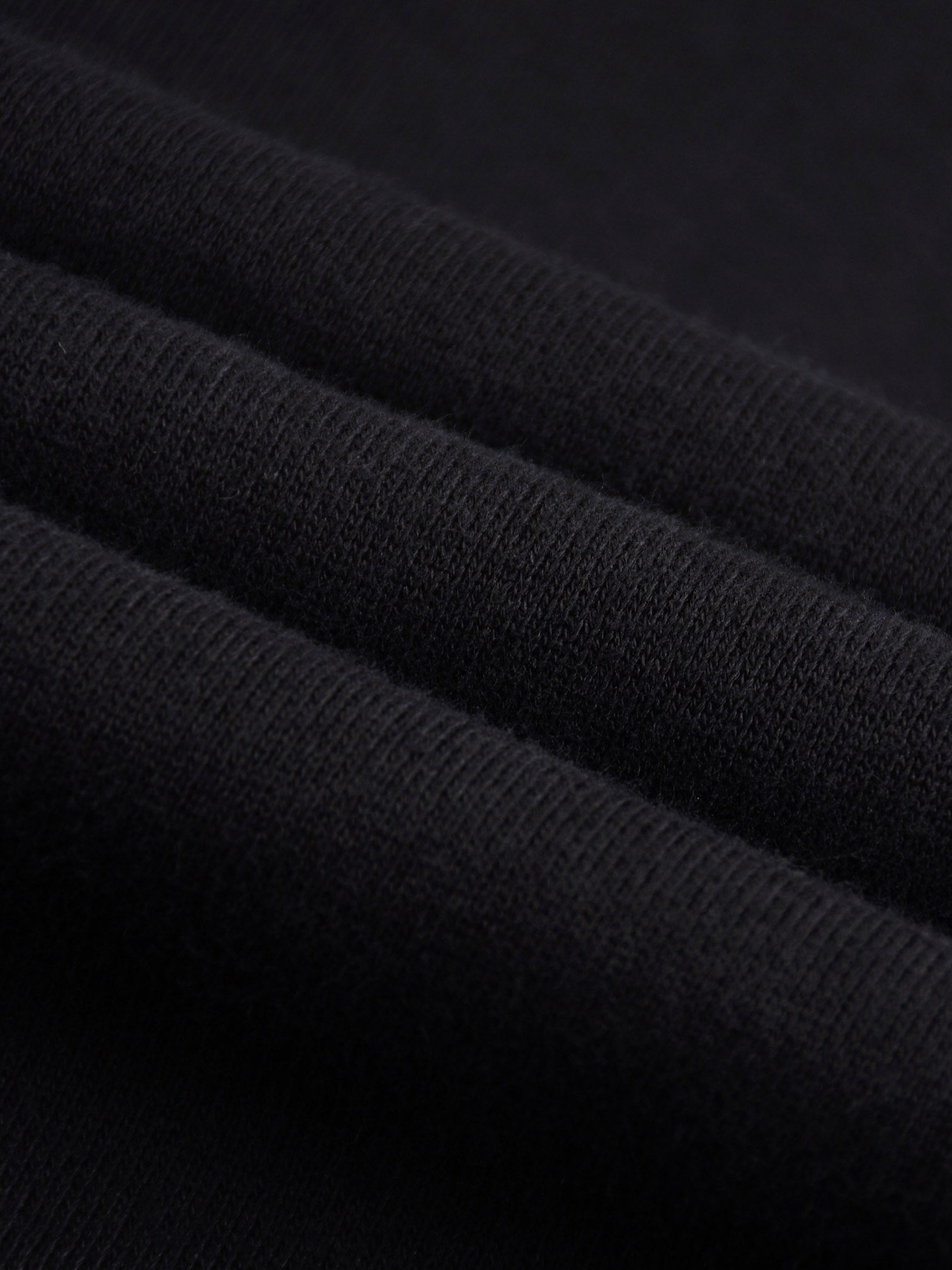
Not all cotton at the same GSM is equal. First-tier textile mills use longer staple cotton fibres, tighter weaves, and more rigorous quality control. The feel difference between first-tier mill cotton and budget mill cotton is immediately apparent in hand. One has a clean, smooth drape. The other has a slightly rough or uneven texture, even at the same weight.
The spec sheet
Brands confident in their product quality list their fabric specs. GSM, mill origin, pre-shrunk treatment, dye process. Brands that aren't confident leave the spec sheet vague or omit it entirely. If a $90 tee's brand can't tell you its GSM, that's information.
The middle ground worth finding
Between fast fashion and premium branding, there's a category that doesn't get enough attention: garments made to the same manufacturing standard as the big brands, without the brand premium applied. First-tier mills. GSM-verified. Pre-shrunk. Colourfast. No logo tax, no packaging markup, no retail margin stacked on top.
The No BS Basic Tee is in this category. So is the Boxy Crewneck and the Heavyweight Hoodie. The manufacturing standard is the same as what the premium labels use. The price reflects the garment — not everything around it.
The practical test
If you're evaluating whether a basic is worth the price:
- Ask for the GSM. If they won't tell you, assume it's not flattering.
- Check if it's pre-shrunk. The answer should be yes.
- Feel it in person if you can. A 220gsm+ tee from a first-tier mill has a noticeably different hand feel from 160gsm fast fashion at room temperature. You'll know.
- Ignore the hang tag. The price of the brand name is not the price of the garment.
Related reading: What Is GSM in Fabric? · Why Are Basic T-Shirts So Expensive? · How to Build a Capsule Wardrobe Without Getting Ripped Off





Share and get 15% off!
Simply share this product on one of the following social networks and you will unlock 15% off!