
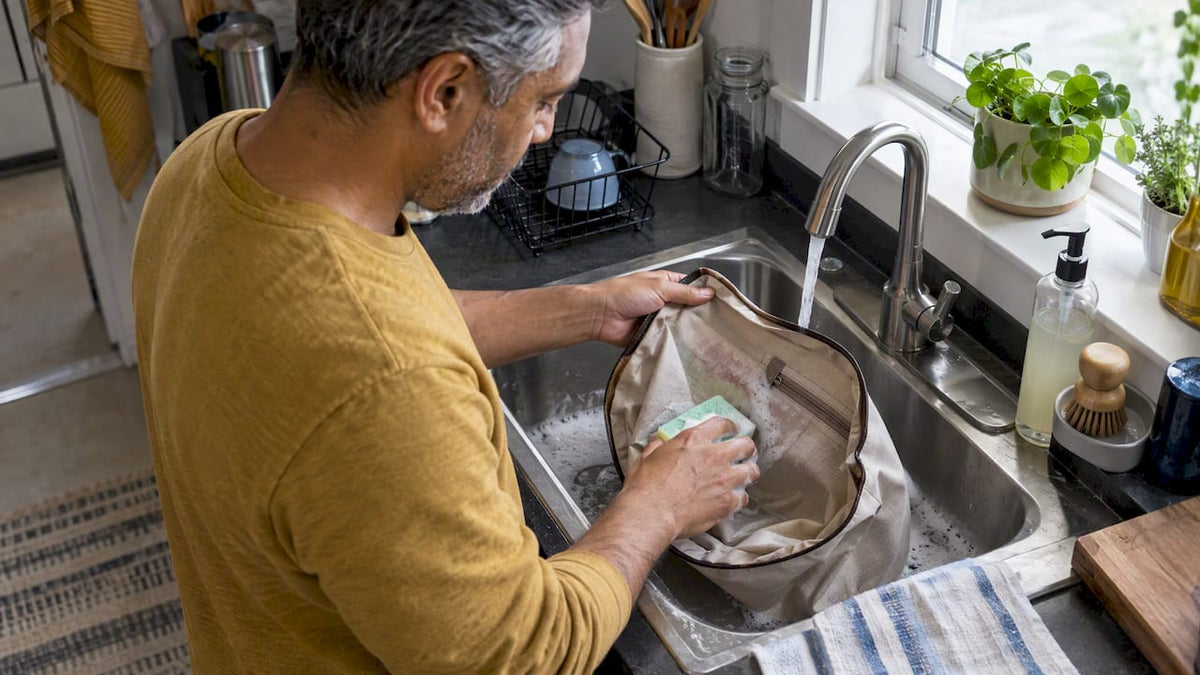
Empty the bag right now, blot the spill with a clean white cloth (never rub), open every compartment and let the bag air out before you put any water or cleaner on it. That order matters more than any product. Perfume is a mix of volatile alcohol and fragrance oils, and the oils are what stay behind in the lining. This guide walks you through the first ten minutes, the right treatment for each lining material, how to get the smell out of a purse that is already dry, and how to stop it from happening again.
TL;DR
- Act fast: remove everything from the bag, then blot (do not rub) with a white absorbent cloth so the oils do not spread deeper.
- Treat by material. A removable, washable fabric lining can take a mild detergent and vinegar soak. Leather, suede and structured bags should not be soaked.
- Once the bag is completely dry, absorb the leftover smell with baking soda or activated charcoal in a breathable sachet, and repeat for several days.
- Test every cleaner on a hidden spot first and check the care label. If the finish is damaged or the smell will not go, see a handbag-restoration or leather professional.
- To prevent a repeat, carry a small leak-resistant atomizer in its own zip pouch instead of a full glass bottle.
Table of Contents
- The First Ten Minutes: What to Do Right Away
- Identify Your Bag’s Interior Before You Clean
- Cleaning a Washable Fabric Lining
- Spot-Cleaning a Fixed Lining or Leather Interior
- Getting the Perfume Smell Out of a Purse
- What Not to Do
- A Quick Plan by Situation
- Our Perspective: Why Spills Happen and What Actually Prevents Them
- How to Stop It Happening Again
- A Better Way to Carry Your Fragrance
- FAQ
- Sources
The First Ten Minutes: What to Do Right Away
Speed decides how much fragrance ends up in the lining, the seams and the padding. The University of Georgia’s cooperative extension guidance on removing cologne and perfume stains is built around the same idea: treat early, treat gently, and match the method to the fabric. Here is the sequence that works for most bags.
- Empty the bag completely. Pull out every item, including the small pockets and the zip compartment. Phones, wallets and paper will absorb perfume too, so set them aside on a clean surface.
- Stand the bag upright or open it wide. If liquid is pooled in the bottom, tip it out over a sink or a towel. Do not shake it so hard that you splash the outside.
- Blot, do not rub. Use a clean, unprinted white cloth or paper towel. Press down, lift, and move to a dry part of the cloth. Rubbing pushes fragrance oils deeper into the fibers and can spread the mark into a larger ring.
- Open every compartment and let the alcohol evaporate. Prop the bag open in a well-ventilated room, away from direct sunlight and heat. Adding water to a wet alcohol-and-oil mix can make a bigger stain, so let the surface dry before you reach for a spot treatment.
- Check the care label and the lining. Whether the interior is cotton, nylon, polyester, leather or suede decides everything that comes next.
A common mistake is treating a perfume spill like a water stain: wiping it with a soaking wet sponge. Water alone does not dissolve fragrance oils, and it can leave a tide mark on lining fabric. Blot first, dry second, treat third.
Identify Your Bag’s Interior Before You Clean
The same remedy can rescue one bag and ruin another. UGA’s textile guidance stresses following the care label and pretesting any cleaning agent on an inconspicuous area. Take 30 seconds to sort your bag into one of these groups.
| Interior material | Safe first approach | Avoid |
|---|---|---|
| Removable, washable fabric lining (cotton, many nylons and polyesters) | Blot, air dry, then a measured detergent and vinegar soak or machine wash per the label | Soaking a lining that is glued or stitched into a structured bag |
| Fixed fabric lining | Blot, air dry, then spot-clean with a barely damp cloth and a drop of mild detergent | Saturating the fabric, which can soak the padding or foam behind it |
| Finished leather | Blot, air dry, then wipe lightly with a barely damp microfiber cloth | Soaking, rubbing alcohol on the finish, heat |
| Suede or unfinished leather | Blot, air out, then use dry odor absorbers kept off the surface | Water, vinegar, powders pressed into the nap |
| Coated or polyurethane-finished interior | Blot and air out, then absorb odor with a sachet | Strong solvents, which can mark or soften the finish |
The last row deserves a note. A French handbag-care guide on perfume spilled inside a bag explains that the volatile alcohol in perfume can attack a polyurethane finish from the inside, while the scented oils leave a lasting mark on the lining. If a coated interior looks tacky, cloudy or sticky after a spill, stop treating it at home and ask a professional.
Cleaning a Washable Fabric Lining
If your bag has a lining you can remove, or a soft unstructured tote that the care label says can be washed, you have the easiest case. UGA lists two fabric options for perfume stains.
Option one: cool water and detergent. Sponge or soak the stain in cool water, apply detergent to it, then launder as the label allows.
Option two: a vinegar soak. Mix 1 quart of warm water, 1/2 teaspoon of detergent and 1 tablespoon of white vinegar. Soak the fabric for 15 minutes, then rinse with water. This is for washable fabric only, so do not use it on leather, suede or a non-washable structured bag.
If a mark remains after that, UGA lists rubbing alcohol as a later step for suitable washable fabrics, followed by a thorough rinse and laundering. The same guidance warns that alcohol can damage acetate, triacetate, modacrylic and acrylic fibers. If you do not know your fiber content, skip this step, or test it on a seam allowance or an inside corner first.
A few practical tips:
- Remove metal charms, detachable straps and leather trim before soaking anything.
- Rinse until no soapy residue is left, because leftover detergent attracts dirt.
- Dry the lining fully in open air, away from direct heat. Damp fabric kept in a closed bag is how a perfume smell turns into a musty one.
Spot-Cleaning a Fixed Lining or Leather Interior
Most handbags do not have a lining you can pull out. For those, the goal is to use as little moisture as possible.
A guide from a leather-goods maker on cleaning the inside of a leather bag recommends emptying the bag first, then vacuuming corners and seams with a soft brush attachment to remove dust and crumbs. After a perfume spill, do this once the bag is dry, because a dry bag lets you see where the oils settled.
Then:
- Dampen a microfiber cloth and wring it until it is barely damp.
- Add, at most, a single drop of mild dish detergent to the cloth, not to the bag.
- Wipe the lining in light strokes, working from the outside of the mark toward the center.
- Go over the area with a second cloth dampened with plain water, then press with a dry towel.
- Leave the bag open to dry fully before you close it or refill it.
Before any of this, test the cloth on a hidden spot such as the inside of a pocket. If color transfers to the cloth or the surface darkens and stays dark after it dries, stop.
For suede and unfinished leather, skip water completely. Blot, air the bag out, and use a dry odor absorber (see the next section) that does not touch the surface. If the spill has left a visible mark on these materials, take it to a leather specialist before you try anything else.
Getting the Perfume Smell Out of a Purse
The visible liquid can be gone and the smell can still be strong. Fragrance reaches seams, pockets, foam padding and the base of the bag, and it keeps releasing for days. Searching for how to get perfume smell out of a purse usually means this stage: the spill is handled, the odor is not.
Step 1: Air it out the right way
Place the empty bag, fully open, in a well-ventilated spot out of direct sunlight and heat. Sun and heat can fade fabric and dry out leather. Turn it over and open the pockets. Give it a day or more.
Step 2: Use baking soda or activated charcoal in a sachet
Once the bag is completely dry, put baking soda or activated charcoal into a breathable pouch (a clean cotton sock, a small muslin bag or a mesh sachet) and leave it inside the bag for several days. Close the bag loosely so air can circulate, or leave it open.

The point of the sachet is that nothing touches the material directly. Keep loose powders away from suede, unfinished leather, metal hardware and any damp surface. Replace the sachet every few days. A small spill can take repeated rounds, because fragrance can remain in the lining and padding.
Step 3: Do not mask it
Dryer sheets, fragrance sprays and scented sachets cover the smell for a day and then mix with it. The bag ends up smelling like two things. Stick with absorbers, which pull odor out instead of adding to it.
Step 4: Repeat, then decide
If the odor is still obvious after a week of fresh sachets and airing, or if the finish has been damaged, a handbag-restoration or leather professional is the sensible next call. This matters most for a bag you paid a lot for or one with sentimental value.
What Not to Do
- Do not rub. It spreads the oils and can roughen the lining surface.
- Do not use a hair dryer or radiator to speed things up. Heat can set the oils and warp leather and coatings.
- Do not soak a structured bag. Water can get into the padding and glue and cause stains, swelling or mildew.
- Do not mix cleaners. Combining household products without knowing what they contain is a safety risk, so use one method at a time and rinse between them.
- Do not skip the hidden-spot test. Care labels and the UGA guidance both come back to this.
A Quick Plan by Situation
It just happened, and the bag has a washable lining: blot, empty, air briefly, then use the 15-minute vinegar and detergent soak or machine wash by the label. Dry fully.
It just happened, and it is a leather bag: blot, open everything, air out of the sun, wipe with a barely damp microfiber cloth once the surface is dry, and then use a sachet.
It happened last week and the bag just smells: vacuum the seams, air the bag, and run baking soda or charcoal sachets for several days, swapping them out.
The finish looks cloudy, tacky or stained: stop, photograph it, and see a professional.

Our Perspective: Why Spills Happen and What Actually Prevents Them
We make refillable perfume atomizers, so we hear about this problem from the other side. In our experience the spill is rarely a freak accident. It is usually a full glass bottle, a loose cap, a bag that gets squeezed on a train or a plane, and a bottle that has been rolling around beside a laptop charger.
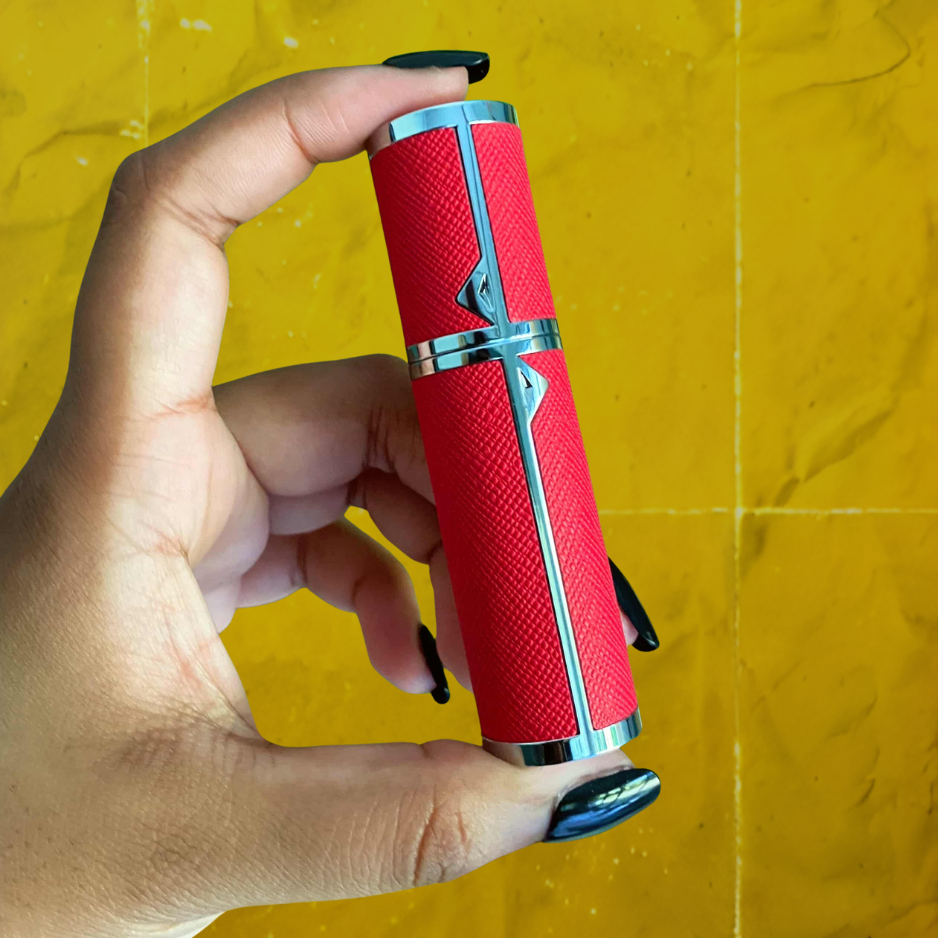
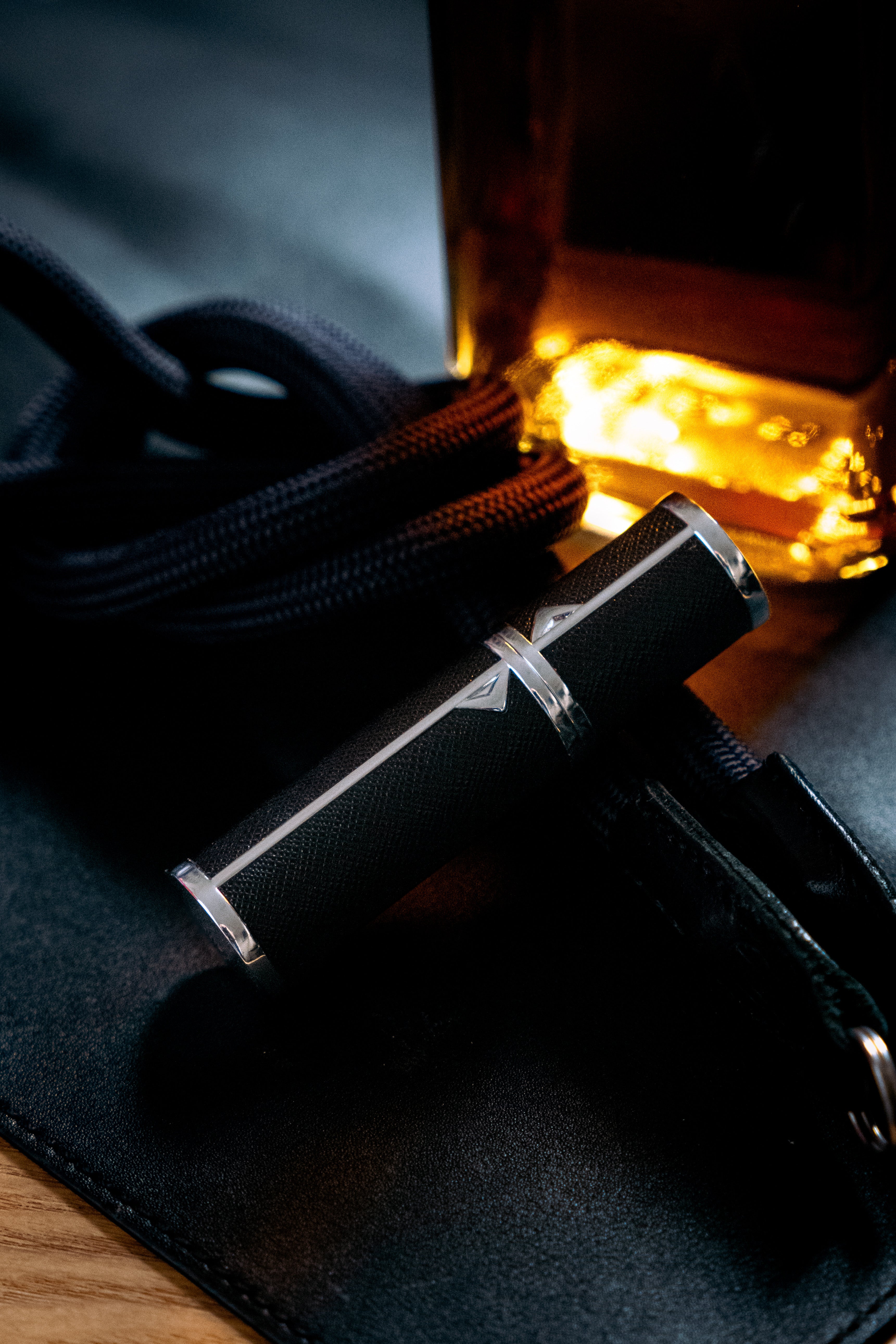
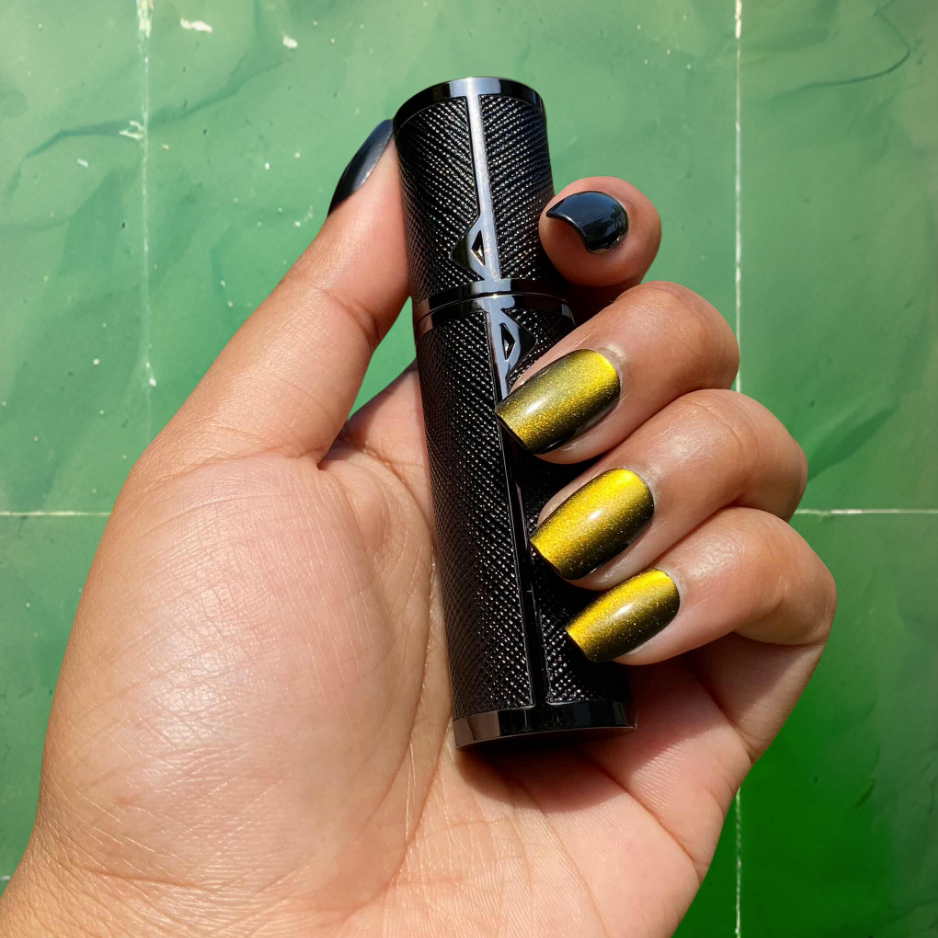
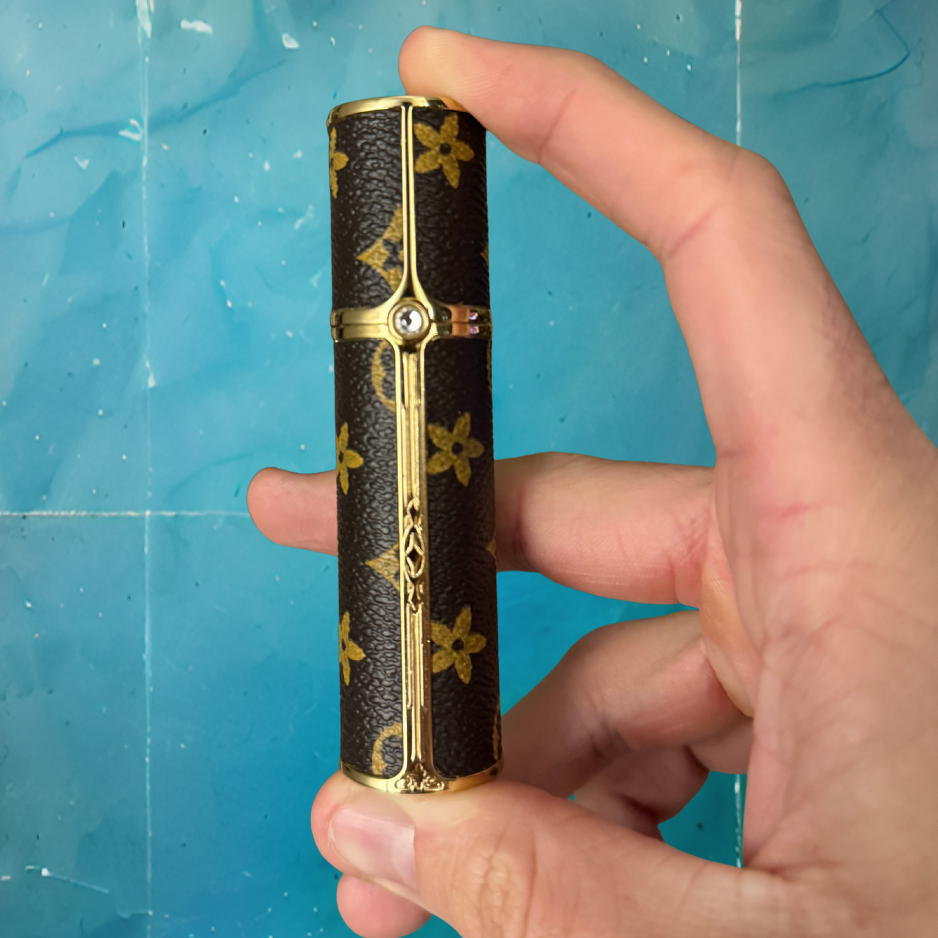
The fix is not a better cleaning routine. It is carrying less liquid, in a container built for being carried. A small atomizer holds only the amount you will use that day, and if it does fail, you are dealing with a few sprays instead of a few ounces. That is also why we design ours to refill from any standard perfume bottle, so you do not have to decant into something flimsy.
We will be straight about one thing: no container is guaranteed leak-proof in every situation. Federal rules on accurate product claims for leather goods and bags treat durability and ease-of-cleaning statements as material consumer information, and that is the right standard. Our atomizers are designed to be leak-proof and airline-approved, but the seal still needs checking, the atomizer still should not be overfilled, and it still belongs in its own pouch. Those habits do more than any single feature.
If you want to understand why atomizers leak in the first place, we wrote about it in why perfume atomisers leak and how to stop it. If you are still decanting, refilling without spills covers the method we recommend.
— Ash
How to Stop It Happening Again
Once your bag is clean, a few habits keep it that way.
Carry a small atomizer, not a bottle
A refillable atomizer reduces the amount of fragrance in your main bag and avoids carrying a bulky glass bottle. Choose a leak-resistant design, and check the seal before packing. Our guide to refilling travel atomizers and stopping at 90% full explains why leaving some air in the container helps, and the same page covers staying TSA-compliant for flights.
Give it its own pouch
Do not let the atomizer sit loose beside clothing, a laptop or a charger. A separate zip pouch contains any leak and keeps scent off your other things. The same logic applies to anything delicate you carry: packing delicate items separately keeps them from tangling, scratching and picking up smells from their neighbors. A dedicated organizer does this job for fragrance too, and you can see ours in the Travel Organisers collection.
Pack it upright and check it after the first hour
Place the atomizer upright in the pouch, with the pump facing up. After the first hour of a trip or commute, check the pouch. A leak caught early is a wipe-down, not a restoration job.
Mind altitude and temperature
Changes in cabin pressure and heat can push liquid through a weak seal. Our walkthrough on flight-ready steps to protect your atomizer covers what to do before you board, and the article on stopping perfume evaporation explains what heat does to fragrance over time.
A Better Way to Carry Your Fragrance
If you have just spent an evening with baking soda and a dry towel, a small change in how you carry perfume is worth making. Our refillable perfume atomizers fill from any standard perfume bottle, fit in a pocket, purse or travel bag, and are designed to be leak-proof and airline-approved. They have an average customer rating of 4.84 from more than 10,000 reviews, and every order comes with free worldwide shipping and a 30-day money-back guarantee. If you are comparing options, our guide to the best travel perfume atomizer lists what to look for.
FAQ
Can I use vinegar on a perfume spill in a leather bag?
No, not as a soak. The vinegar and detergent solution from UGA is for washable fabrics, and it should not go on leather, suede or a non-washable structured bag. For leather, blot, air the bag out and wipe lightly with a barely damp microfiber cloth after testing a hidden spot.
How long does perfume smell last in a bag?
It depends on how much spilled and what the lining and padding are made of. A small spill can take several days of repeated odor absorption, and sometimes longer, because fragrance stays in the lining and foam. If the smell is still strong after a week of fresh sachets and airing, ask a handbag-restoration or leather professional.
Does baking soda damage a purse?
Used in a breathable sachet, it is a gentle choice for most interiors, because it does not touch the material. Keep loose powder away from suede, unfinished leather, metal hardware and damp surfaces. Make sure the bag is completely dry first.
Should I spray something to cover the smell?
No. Dryer sheets and more fragrance only layer a new smell over the old one. Absorbers such as baking soda or activated charcoal, plus airing, are the better route.
Is a refillable atomizer less likely to leak in a bag?
It carries far less liquid than a full bottle, so a failure is much smaller. Check the seal before you pack it, avoid overfilling, and keep it upright in a separate zip pouch. No container is leak-proof in every condition, so those habits matter.
Sources
- University of Georgia Extension: Remove Stains From Cologne/Perfume
- Yukon Bags: How to Clean the Inside of a Leather Bag
- Maison Tanger: Parfum renversé dans un sac
- eCFR: 16 CFR Part 24, Guides for Select Leather and Imitation Leather Products




साझा करें और 15% छूट पाएं!
बस इस उत्पाद को निम्नलिखित सामाजिक नेटवर्क में से किसी एक पर साझा करें और आपको 15% की छूट मिलेगी!